 In Love With These Times: My Life with Flying Nun Records by Roger Shepherd, Harper Collins NZ, 2016
I once asked Kim Salmon to explain the extraordinary flowering of early punk in Australia. I’m from Toronto after all, just up the road from New York. We had a few notable bands in this era but nothing on par with The Saints, Radio Birdman, or indeed Kim’s outfit, The Scientists. He had no idea. But he did offer his own experience as a possibility. The Scientists’ early sound, he told me, was based on what he thought punk might sound like after reading about it in a six month old issue of the NME. There were no punk records in the shops in Perth or Brisbane. Early Australian punk avoided being derivative because no one had actually heard the music.
How’s that for a theory? Isolation breeds original music. There should be some great music coming out of places like Reunion Island then. Well, ever heard of Rene Lacaille? And what about Dunedin on the south island of New Zealand? That should be a veritable wellspring of creativity in music. According to Roger Shepherd’s new memoir, In Love With These Times: My Life with Flying Nun Records, that is exactly what it is.

The Clean
The Clean, The Chills, The Verlaines, Tall Dwarfs, Sneaky Feelings, and The Bats are hardly household names but they are all associated with the influential ‘Dunedin Sound.’ Roger Shepherd notes that, in the early 80s, Dunedin bands went in for reverb, drone, and jangle (without the jingle). Sound familiar? Fans of LA’s Paisley Underground scene will recognize the same brushstrokes but might be surprised to note that some of these New Zealand bands got there first or least at the same time. Listen to Sneaky Feelings’ ‘For Pity’s Sake’ from the 1982 ‘Dunedin Double’ compilation EP if you don’t believe me. Michael Stipe, it should be noted, credits the sound as a major influence on REM’s early albums.
Roger Shepherd founded Flying Nun Records in 1981 while working in a Christchurch record store. The most interesting sections of the book are in the first few chapters where he describes the excitement of punk’s initial stirrings in New Zealand. He tells a funny story about a friend who in 1976 predicted that the future of popular music was something he called ‘Space Rock’. Three weeks later, a new issue of the NME proclaimed the arrival of punk. Space Rock would have to wait. Hopefully for a long time!
Shepherd almost accidentally started the company by releasing two singles (‘Ambivalence’ by The Pin Group and ‘Tally Ho’ by The Clean) in 1981. He saw a lot of bands and thought that other people should hear them. Compared to, say, Mushroom Records’ Michael Gudinski or someone like David Geffen, Shepherd is a modest fellow indeed. It only occurs to him that he is the owner of Flying Nun when he meets someone in a pub claiming he is instead. It takes him years to get up enough nerve to quit his day job. This is a long way from SST Records being infiltrated by the FBI. But still, these chapters are like snapshots of a lost world in rock and roll. From the four track recorder in someone’s living room to the surprise entry into the national charts, there has never been a time like the pre internet early 80s for tiny record labels.

The Verlaines
The gap between mainstream and ‘alternative’ music was far more pronounced than it would be ten years later. The major labels in the 1980s were so powerful and so rich that it was almost impossible to challenge them in the market. Anyone feeling sad about the more recent disruption of the record industry by online piracy might reflect on the effect of this stranglehold on music. Labels like Flying Nun were fighting a real David and Goliath battle with the majors in those days. New Zealand radio was filled with the same bathwater that everyone was subjected to in the early eighties while volunteers packed envelopes with little heard but gloriously creative 45s. Roger Shepherd is far too humble to say so but he, along with his many counterparts all over the world, were revolutionaries. The overused word ‘alternative’ really meant something in those days. When The Eagles Junta was in power, small labels kept us safe!
Speaking of politics, New Zealand in 1981 was experiencing one of its more dramatic moments. A controversial tour by the South African rugby team, the Springboks, divided the country sharply. The protests were enormous and several games were actually stopped. It’s not a overstatement to say that the international attention that the protests brought to the situation in South Africa was a significant step towards the end of Apartheid. Shepherd weaves this story into his own. He doesn’t overdo it but there must be some connection between New Zealand’s birth as a liberal minded nation on the world stage and the sudden appearance of so much great rock and roll.
 In the late 80s, Flying Nun Records relocated to Auckland before it was more or less taken over by Australia’s Mushroom label in 1990. Roger Shepherd moved to England where he was eventually pushed out of the label completely when Mushroom itself was taken over. In 2010, he regained control of the label with the help of fellow Kiwi Neil Finn. By this time, Flying Nun Records was recognized in New Zealand as a national treasure that deserved to survive.
Throughout the book, Roger Shepherd seems curiously removed from the music itself. His intentions were, and remain, to distribute music that he enjoys. That said, he says very little about the music. The book certainly has its moments. His descriptions of Chris Knox on stage as the lead singer of Dunedin Sound ur band, The Enemy are vivid and compelling. The story of how Flying Nun inadvertently released a bootleg of The Fall is of interest too. But there is still a book to be written about the ‘Dunedin Sound’. Roger Shepherd is a likeable guide to his label’s history but a scene that can produce so many bands playing so much deep music requires a far more thorough investigation.
Teaser: The story about the stolen cactus with narcotic properties, the enema kits, and the missing ginger ale is sufficiently weird to remind you that we’re talking about New Zealand here, after all.
 Murray Talks Music: Albert Murray on Jazz and Blues by Albert Murray and Paul Devlin (Editor), University of Minnesota Press, 2016
 His love of jazz goes far beyond his vast knowledge of the music and its players. For Murray, jazz is the purest form of American art. Like the country itself, it is about innovation and improvisation. Jazz music, he says, is the sound of a restless nation pushing against boundaries and frontiers. It is also, for Murray, an African American art form. Some of his critics, notably Terry Teachout, have suggested that he underrated white jazz artists but Murray’s views here are far more complex. His position was that the race problem in America is one of definition and artificial lines. America for Murray was an idea, rather than a geopolitical or economic entity. He believed that African Americans were the ‘real’ Americans because they arrived from Africa with no language and no culture. They absorbed the culture of America and practiced it in its purest form, untainted by a sense of Europe as a center. They were thus able to create jazz, the greatest and perhaps only truly American art form. His first book, The Omni Americans (1970), a response to Patrick Moynihan’s damning 1965 report on the state of African Americans, suggests that the way forward could be in a redefining of American culture, to recognize the contribution of everyone involved, rather than any one group. Sadly, this probably still seems overly idealistic almost 50 years later. However, while pondering this, it occurred to me that the blues heritage of Mississippi and Chicago are now institutionalized in a manner that would have seemed unlikely even 25 years ago. When I visited Maxwell Street, Chicago, in the early 90s, the market was closed and there was no sign that this was one of the crucibles of American music. It is now heritage listed, the market has reopened, and tourism has revived what was a very depressed neighbourhood. Richard Daley’s son, of all people, made this happen! It would be lovely to think that we might one day say that music provided the groundwork for a real change in race relations in America.


 Every Song Ever: Twenty Ways to Listen in a Musical Age of Plenty by Ben Ratliff, Farrar, Straus and Giroux, 2016
 The chapter on ‘Transmission’ is particularly interesting. He quotes the 19th century writer Evard Hanslick who wrote that ‘music mimics the motion of feelings’. This rather romantic idea was dismissed by the formalist critics of the early 20th century who tried to quantify the effects of music with elaborate theory and somewhat pseudo scientific ideas about our relationship to it. Ratliff points to the Sufi tradition and the wildly spiritual music of Nusrat Fateh Ali Khan as evidence that the place where music comes from is no simple matter. John Lennon’s performance of Julia, one of his great moments, is mentioned here too.
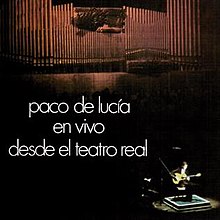 But the other aspect of this book is the examples that he uses to illustrate his various claims. The book is not long, 272 pages, but it will take you weeks to read because you can’t help tracking down the songs and albums he mentions. They are threaded through the text and featured in a list at the end of each chapter. Hence the serendipitous appearance of this book as I vowed to listen to more unfamiliar music. In the ‘Slowness’ chapter, I discovered Dadawah’s Peace and Love album, some magic mid seventies reggae. The ‘Discrepancy’ chapter yielded Willie Colon’s Lo Mato album from 1973. The improvisation chapter alerted me to the music of Derek Bailey, an avant garde guitarist, and Paco De Lucia’s scorching 1975 En Vivo Desde el Teatro Real album. So much good stuff. I ended up keeping a notebook nearby so I could make a list of albums, both known and unknown, to listen to later. It’s that kind of a book.
 Under the Big Black Sun: A Personal History of LA Punk, John Doe with Tom DeSavia and Friends, De Capo 2016
 So this is an unfamiliar LA, a city of derelict apartment blocks filled with misfits who are making films, writing poetry, and forming bands like The Go Gos. It’s a night place where a bunch of disaffected kids come together and try something different. All of them had grown up in the Watergate 1970s and the slow death of the 60s dream. Like their counterparts in New York, London, Sydney, and Toronto, they weren’t interested in the bloated rock music on the radio so they made it new. Henry Rollins says that history is filled with moments where someone stands up and says ‘Fuck this. No seriously, fuck this.’ This is what happened in LA in 1977.
 Punk began in LA as the music of the outsider. There is a fine essay by Teresa Covarraubias of the band The Brat, about the scene in East LA and the contribution of Latino bands like The Plugz – who once backed Bob Dylan on Letterman. Yes, Los Lobos makes an appearance here. They once opened for PIL. What happened? Guess. It involves saliva. Her essay ends, however, on a sad note about the night that a local hall, The Vex, was destroyed by the violent suburban punks who began to dominate the scene in the early 80s. They were, for the most part, white and male. The diversity of the early scene didn’t last long. When the bullyboy skins from Orange Country turned up, women too drifted away from what had been a remarkably progressive moment in rock and roll.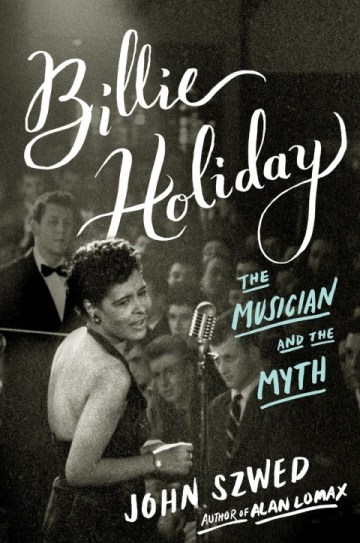
 As if to make this plain, the first section deals with the ‘myth’ and, specifically, the autobiography Holiday produced in 1957. Lady Sings the Blues was much read at the time but is a book that has always been considered fictitious. He points out that she was forced to suppress the sections that dealt with many of her friendships and romantic relationships. Orson Welles, Charles Laughton, Tallulah Bankhead, Elizabeth Bishop, and several other notables threatened legal action if they were mentioned. Billie’s problems with heroin and her troubles with the law were both well known by the 1950s. No one wanted to be publicly associated with her. The book then became a hodgepodge of stories that emphasized her troubled life. Szwed suggests that the book isn’t fictitious, just incomplete. Like all biographical writing, it reflects the values of the period in which it was written. There is a glut of rock and roll memoirs on the shelves in bookstores at the moment. The selling point is, of course, the opportunity to hear the ‘true’ story from the horse’s mouth. Billie’s autobiography is a reminder that the ‘truth’ is no simple matter.
 1966: The Year the Decade Exploded, Jon Savage, Faber and Faber 2015
 At the moment on my coffee table, there are books called 1607 (James Shapiro’s follow up to 1599), 1966, Detroit 67, and a novel by Garth Risk Hallberg called City on Fire which appears to be set entirely in 1977 although it’s 900 pages long and I’m only halfway through it. It might be 1979 when I finish. Or 2017. On my kobo, there is a book by David Browne called Fire and Rain that is all about 1970 and one from a few years ago called 1968 by Mark Kurlansky. They are all of interest but when ‘1996’ appears, don’t expect a review. I didn’t like anything about that whole decade.
 Some of these chapters are more convincing than others. His evocation of homosexuality in 1966 is particularly well done. The Tornados ‘Do you come here often?’, is widely thought of as the first ‘gay’ pop song – for those who missed the subtext of Tutti Frutti and countless other 1950s singles. Joe Meek, the legendary producer of this song, had begun his long slide into the madness that would end in his death in 1967. Like Brian Epstein, he led a secret life and had been subjected to arrest and blackmail attempts over the years. The laws were changing but it was still a difficult time to be gay in England. The chapter also picks up the story of San Francisco in that year. The Gay rights movement, in most people’s minds, begins with Stonewall in 1969 but Savage shows that it was already crystalising in 1966.
 ‘global village’ by 1966 and most of the events in the UK and US were mirrored in other places. Others may be able to point to music related events in Africa or even the Middle East. Please point!
 Lives of the Poets (with Guitars): Thirteen Outsiders Who Changed Modern Music Ray Robertson, Biblioasis 2016
 Many novelists attempt this trick. Not many get there. Novels about rock and roll bands usually fall in a great big heap when the writer tries to describe the music. I’m happy to be corrected on this one. Please drench me in the names of credible rock and roll novels. I can think of three. The Doubleman is one, Paul Quarrington’s Whale Music is another. The final and greatest of all is Ray Robertson’s 2002 novel, Moody Food.
 The first essay on Gene Clark sets the tone (and the volume, ha ha!). Clark is a notable cult figure. His album No Other can sit comfortably next to a whole bunch of other ambitious and brilliant albums that were completely ignored when they appeared. Clark’s sad tale is a staple of magazines like MOJO and Uncut but Ray tells it in such an affecting manner that it felt as though I was reading it for the first time. This musician’s musical journey was an unusual one that spanned several decades. Ray uses his considerable storytelling abilities to give his music a cohesive frame. This would be insupportable if the music wasn’t described with such clarity and detail. I could hear these albums as I read. That’s impressive.


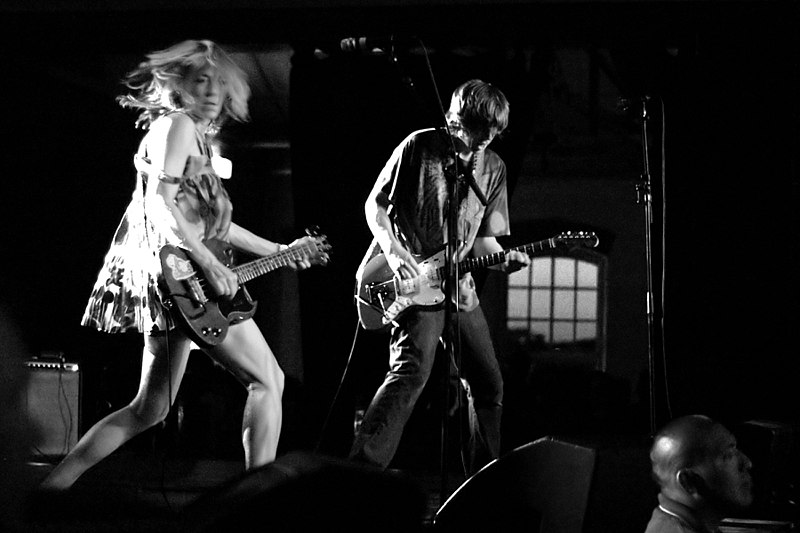 I am not a hardcore Sonic Youth fan. I saw them once, opening for Neil Young, and I have two or three of their albums. The wonderful thing about this book is that it doesn’t matter. She has so many interesting things to say about art, about her friendships with people like Kurt Cobain, her experiences as a woman in the blokey world of alternative rock, motherhood, and her brief time as a fashion designer. I suspect that even readers who had never heard of Sonic Youth would be charmed by her story. That said, fans will relish the detail with which she outlines how certain songs came to be written. She is clearly inspired by the books she reads and she mentions many of them. Keep a pen handy.
 Detroit 67: The Year That Changed Soul Stuart Cosgrove, 2015
 Detroit 67 begins with a long section outlining the day to day activities and troubled internal relations of The Supremes. The Motown gossip is here – yes, Berry Gordy was involved with Diana Ross – but the focus is on Florence Ballard who will, in Cosgrove’s account come to embody, not only the move by Motown Records towards a more corporate model, but also the decline of Detroit itself. The story then shifts rather abruptly to John Sinclair and the beginnings of the MC5. The connection, at first, seems tenuous. Sinclair hated Motown, though he had once shopped in Gordy’s unsuccessful record store for obscure jazz sides. The MC5 were about as far removed from The Supremes as would be possible in one city.
 “It Takes Two” Diana Ross and Rob Tyner

 Small Town Talk by Barney Hoskyns, Da Capo Press 2016
 He thought that she was something truly special. And he was right! Anyone else noticed that Janis seems to be out of fashion at the moment? What’s that about?
 On Books On Music