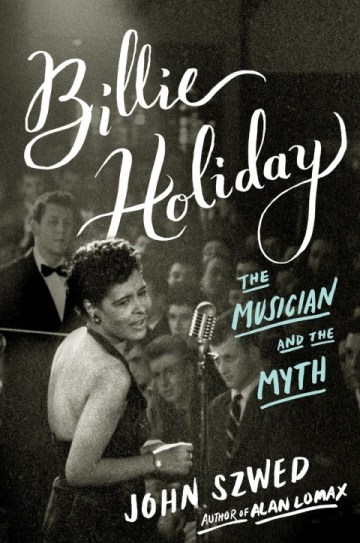
Billie Holiday: The Musician and The Myth John Szwed, Viking 2015
“So we beat on, boats against the current, borne back ceaselessly into the past.”
Billie Holiday sounds a bit like those boats. She drifts back from the beat and takes whatever time she needs to tell her story. It is almost her signature. But this was more than merely style. The substance of her art was the raw humanity of that voice. We’re all a bit behind the beat, as Nick Carraway reminds us. That’s what I hear in Billie Holiday.
There are two chapters about the way she sang in John Szwed’s new book, Billie Holiday: The Musician and the Myth. It was never a strong voice and her range was barely one octave. Teddy Wilson, with whom she made so many great records, said he preferred Barbara Streisand when asked about Billie later in life. Barbara Streisand! I mean, really! Billie herself was ambivalent about what she famously called her ‘old voice’. But that old voice was as much a wonder of the 20th century as F. Scott’s novel. She sang and she spoke at the same time. The French call this ‘diseuse’. Szwed claims that it is what gives her songs so much warmth.
The subtitle of the book, the musician and the myth, is appropriate. Szwed works hard to separate the two and explore the musical rather than the personal. And this isn’t easy. Her life was a sad one, a really sad one. The temptation to explain the pathos of her singing in terms of the lousy childhood, the drug addiction and so on is great. Very few writers have managed to avoid the black hole of biographical fallacy when writing about Billie. Hence, a book that looks at her music on its own terms instead of as an expression of her ‘tortured soul’ is a welcome addition to writing about Billie and about jazz in general. Writers such as Elijah Wald have recently called out the standard ‘blues’ biography as a racist white fantasy. This book avoids the overemphasis on ‘otherness’ and is far more informative for it.
 As if to make this plain, the first section deals with the ‘myth’ and, specifically, the autobiography Holiday produced in 1957. Lady Sings the Blues was much read at the time but is a book that has always been considered fictitious. He points out that she was forced to suppress the sections that dealt with many of her friendships and romantic relationships. Orson Welles, Charles Laughton, Tallulah Bankhead, Elizabeth Bishop, and several other notables threatened legal action if they were mentioned. Billie’s problems with heroin and her troubles with the law were both well known by the 1950s. No one wanted to be publicly associated with her. The book then became a hodgepodge of stories that emphasized her troubled life. Szwed suggests that the book isn’t fictitious, just incomplete. Like all biographical writing, it reflects the values of the period in which it was written. There is a glut of rock and roll memoirs on the shelves in bookstores at the moment. The selling point is, of course, the opportunity to hear the ‘true’ story from the horse’s mouth. Billie’s autobiography is a reminder that the ‘truth’ is no simple matter.
The second section, The Musician, begins with a chapter called ‘The Prehistory of a Singer’. In setting the stage for her career, Szwed reaches back to the minstrel shows of the 19th and early 20th century. There is no more complex period in American music with regard to race. And it lays the foundations for all the complexity to come. If you feel like sending yourself down a moral rabbit hole in regard to the music you revere, read Love and Theft by Eric Lott or Where Dead Voices Gather by Nick Tosches. In this book, Szwed notes that Billie herself had to ‘black up’ occasionally in her early days. Confused? Welcome to American music!
This chapter also highlights her high level of musicality. A classical musician who spent an afternoon with her at the piano thought that she was the most intelligent listener he’d ever encountered. She didn’t read music and did not write songs as such (discussed in another chapter) but like so many of the great jazz artists, she had an intensely musical aura. Watch the clip below. Emotional? Sure. Physical? Yes. Spiritual? Absolutely.
Billie’s first two recordings were with Benny Goodman. She also worked with the Basie band and there found a musical soul mate in saxophone genius, Lester Young. He named her Lady Day, she called him Prez, as in President of the Sax. But her most dramatic association was with Artie Shaw. There is a movie waiting to be made about their tour of the American south in the late 1930s. Black singers with white bands weren’t that unusual but they didn’t normally head to Georgia or Alabama together. Billie had to be escorted everywhere by the toughest members of the band. Shaw insisted she be treated equally in hotels, restaurants, and at the venues they played. This caused no end of trouble and eventually Holiday simply quit. She cited the fact that getting a sandwich or going to the bathroom always turned into a ‘major NAACP production’ on the tour.
There should be a warning on the cover of this book: Beware – you will feel compelled to read passages aloud to family, friends, and total strangers. It’s that sort of book. Fascinating facts and compelling stories fall off the page. You will also need access to her recordings. Szwed covers a lot of songs here and I’m pretty sure you will want to hear all of them. A top read for fans and novices alike.
Teasers: Strange Fruit – the whole damn story! The time Rita Hayworth got really angry with Orson Welles! Tallulah Bankhead’s throwdown to Peggy Lee! Billie Holiday, babysitter!
Watch this. Billie and Lester Young together again after years apart. They were both gone within 18 months. Heartbreaking clip.
 1966: The Year the Decade Exploded, Jon Savage, Faber and Faber 2015
 At the moment on my coffee table, there are books called 1607 (James Shapiro’s follow up to 1599), 1966, Detroit 67, and a novel by Garth Risk Hallberg called City on Fire which appears to be set entirely in 1977 although it’s 900 pages long and I’m only halfway through it. It might be 1979 when I finish. Or 2017. On my kobo, there is a book by David Browne called Fire and Rain that is all about 1970 and one from a few years ago called 1968 by Mark Kurlansky. They are all of interest but when ‘1996’ appears, don’t expect a review. I didn’t like anything about that whole decade.
 Some of these chapters are more convincing than others. His evocation of homosexuality in 1966 is particularly well done. The Tornados ‘Do you come here often?’, is widely thought of as the first ‘gay’ pop song – for those who missed the subtext of Tutti Frutti and countless other 1950s singles. Joe Meek, the legendary producer of this song, had begun his long slide into the madness that would end in his death in 1967. Like Brian Epstein, he led a secret life and had been subjected to arrest and blackmail attempts over the years. The laws were changing but it was still a difficult time to be gay in England. The chapter also picks up the story of San Francisco in that year. The Gay rights movement, in most people’s minds, begins with Stonewall in 1969 but Savage shows that it was already crystalising in 1966.
 ‘global village’ by 1966 and most of the events in the UK and US were mirrored in other places. Others may be able to point to music related events in Africa or even the Middle East. Please point!
 Lives of the Poets (with Guitars): Thirteen Outsiders Who Changed Modern Music Ray Robertson, Biblioasis 2016
 Many novelists attempt this trick. Not many get there. Novels about rock and roll bands usually fall in a great big heap when the writer tries to describe the music. I’m happy to be corrected on this one. Please drench me in the names of credible rock and roll novels. I can think of three. The Doubleman is one, Paul Quarrington’s Whale Music is another. The final and greatest of all is Ray Robertson’s 2002 novel, Moody Food.
 The first essay on Gene Clark sets the tone (and the volume, ha ha!). Clark is a notable cult figure. His album No Other can sit comfortably next to a whole bunch of other ambitious and brilliant albums that were completely ignored when they appeared. Clark’s sad tale is a staple of magazines like MOJO and Uncut but Ray tells it in such an affecting manner that it felt as though I was reading it for the first time. This musician’s musical journey was an unusual one that spanned several decades. Ray uses his considerable storytelling abilities to give his music a cohesive frame. This would be insupportable if the music wasn’t described with such clarity and detail. I could hear these albums as I read. That’s impressive.


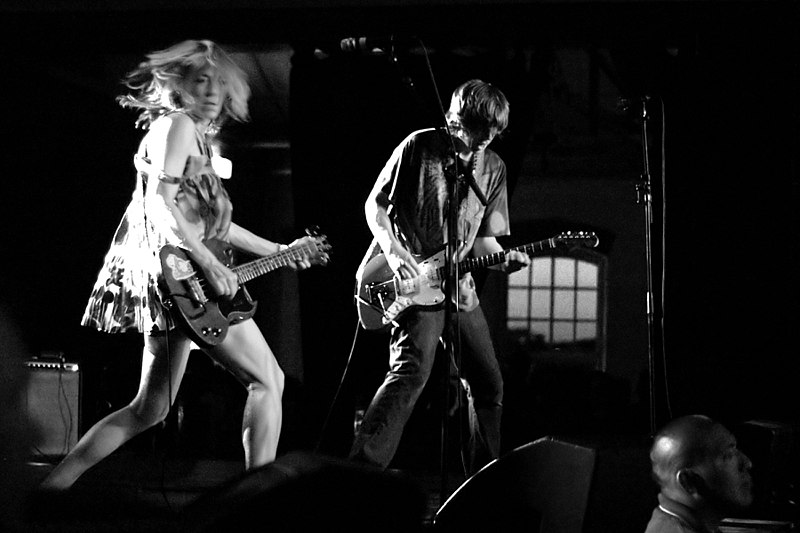 I am not a hardcore Sonic Youth fan. I saw them once, opening for Neil Young, and I have two or three of their albums. The wonderful thing about this book is that it doesn’t matter. She has so many interesting things to say about art, about her friendships with people like Kurt Cobain, her experiences as a woman in the blokey world of alternative rock, motherhood, and her brief time as a fashion designer. I suspect that even readers who had never heard of Sonic Youth would be charmed by her story. That said, fans will relish the detail with which she outlines how certain songs came to be written. She is clearly inspired by the books she reads and she mentions many of them. Keep a pen handy.
 Detroit 67: The Year That Changed Soul Stuart Cosgrove, 2015
 Detroit 67 begins with a long section outlining the day to day activities and troubled internal relations of The Supremes. The Motown gossip is here – yes, Berry Gordy was involved with Diana Ross – but the focus is on Florence Ballard who will, in Cosgrove’s account come to embody, not only the move by Motown Records towards a more corporate model, but also the decline of Detroit itself. The story then shifts rather abruptly to John Sinclair and the beginnings of the MC5. The connection, at first, seems tenuous. Sinclair hated Motown, though he had once shopped in Gordy’s unsuccessful record store for obscure jazz sides. The MC5 were about as far removed from The Supremes as would be possible in one city.
 “It Takes Two” Diana Ross and Rob Tyner

 On Books On Music